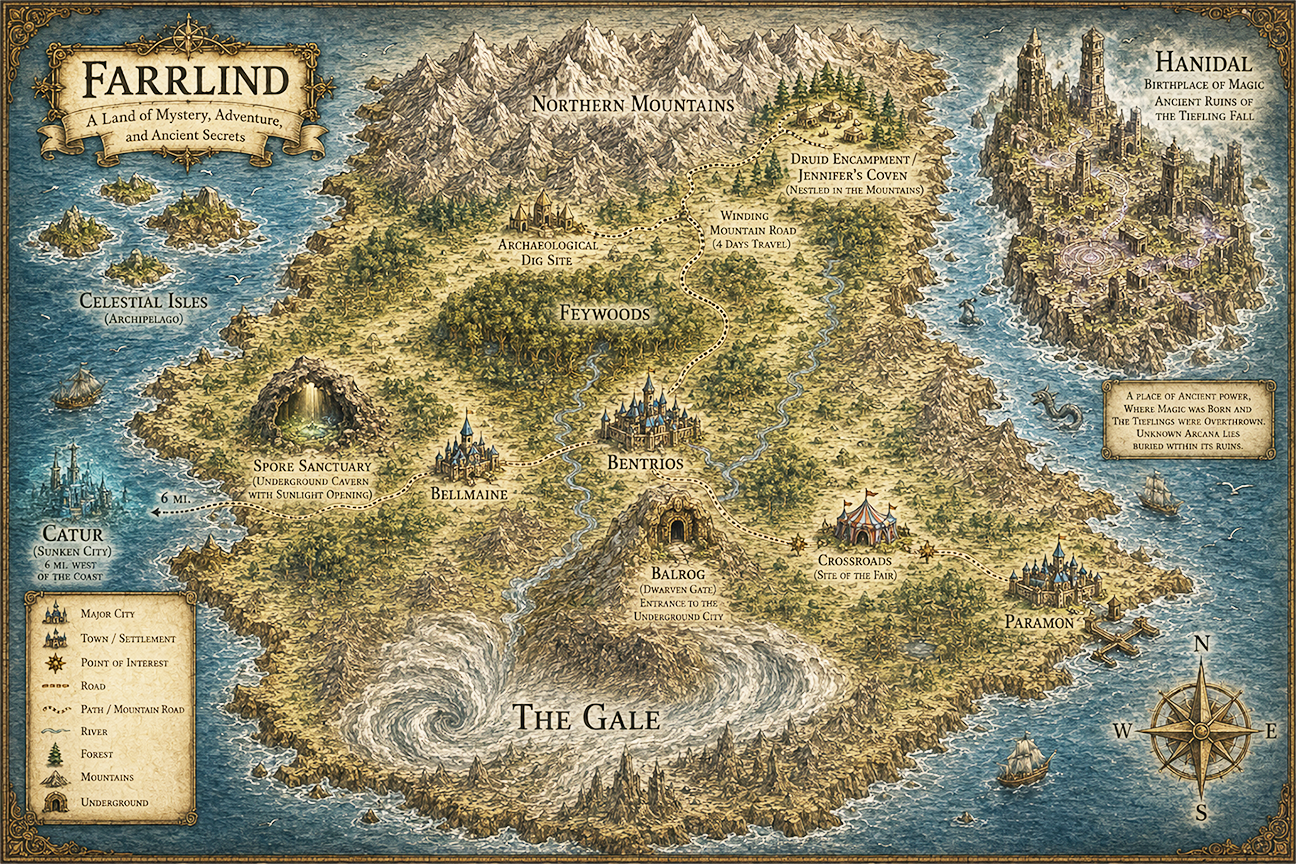
Session Twenty-Eight --- 09/20/26
1832 AS --- Namal 28-29
The Wand Chooses Its Hands
There are masks, dear reader, and there are faces that have simply not
yet decided what they are.
Today we met the difference.
When last I wrote, one of our attackers had become a prisoner. This was
because he attempted to flee through the trapped passage beneath the
Monastery of the Open Hand, and I objected to his departure by means of
Dimension Door.
I remain fond of magic that allows one to disagree with distance.
He was tied tightly, frightened thoroughly, and not especially eager to
die, which made him unusually conversational for a man who had just
tried to kill us.
At first, he insisted he could not tell us who had hired him. There are
many ways a person can say "I cannot," and only some of them mean "I
will not." This one seemed to mean something closer to, "I would like to
continue possessing all of my important pieces."
So I began politely.
Then I stopped.
There are people who believe persuasion and intimidation are opposites.
This is charmingly naive. They are two doors into the same room, and
sometimes the polite door is locked.
The prisoner told us his group had been hired through a tiefling woman.
Not Rayetta. Not one of the monks here. A woman who brought them through
a portal to a very fine place where lightning sounded outside.
Lightning.
That word sat in the air like a blade left on a table.
He did not know the true employer. He did not know enough to save
himself with any grand revelation. He knew a proxy, a portal, a job, and
fear.
Then he showed us what he was.
The shape he had been wearing loosened. Skin, clothing, and pretense all
gave way together, and there before us sat a white, hairless humanoid
figure with red-black eyes and the unsettling appearance of a mannequin
that had heard rumors of people and attempted the form from memory.
A changeling.
I found the name in the book. I confess to some professional pleasure in
that. One likes to be useful in a room full of blades.
The pleasure did not last long. There were still bodies below us.
The Dead Had Pockets
Searching the fallen is an ugly necessity.
It is also, unfortunately, often practical.
The common weapons told us little. Common steel, common bows, the sort of
tools that can be purchased anywhere by anyone who intends to do
something regrettable. The drow was more interesting. He had fought with
a sword of shadow, but upon his body there was only a hilt. No blade.
No ordinary magic clinging to the weapon itself. The magic remained on
him, faintly, stubbornly, in a way that made Gildas think of warlocks.
Warlocks are what happens when ambition signs papers it has not read.
Further searching turned up a symbol we knew too well: the mark of the
Cult of Elemental Chaos.
Of course.
At this point I begin to suspect that if I overturned a teacup in a
quiet village inn, some small wet symbol of elemental chaos would be
underneath it, waiting patiently to ruin breakfast.
The elf had carried stranger things. Foreign tube-weapons, pistols by
another understanding, though at the time they resembled little wands
designed by someone with an unpleasant sense of humor. Gildas examined
one too closely and shot himself in the foot.
Literally.
There are metaphors one should not encourage.
He survived, though only barely enough to feel embarrassed. The weapons
seemed spent or ruined afterward, which is perhaps for the best. We have
enough ways to injure ourselves without adding mysterious hand-cannons
from distant lands.
The elf also carried a pouch.
The pouch jingled with coin and refused to open.
Runes marked the cord. Abjuration held it shut. For one horrifying
moment someone considered putting a magical sealed pouch inside the Bag
of Holding, which would have been an elegant way to turn our entire
investigation into a cautionary tale about container etiquette.
We did not do that.
I mention this because survival is sometimes the result of heroic
courage, and sometimes it is the result of remembering not to put one
impossible space inside another impossible space.
The pouch went into an ordinary pack.
Ordinary packs deserve more praise.
Wayne, Who Was Not Wayne
We took the prisoner to Mother Hestera.
This was made somewhat complicated by the fact that we had left the
secret passage open, and monks had begun gathering around the hole in
the wall with the understandable expression of people discovering that
their monastery contains previously unadvertised architecture.
Mother Hestera was not pleased.
This is like saying the Gale is a little chilly.
We told her everything. The passage. The fight. The books. The prisoner.
The tiefling proxy. The symbol. Rayetta's help in battle, which I took
care to mention because credit is one of the few currencies that costs
nothing and is still too rarely paid.
Then Hestera asked how long they had been inside her monastery.
The prisoner told us.
Months.
He had come here wearing the face of someone named Wayne.
Wayne.
The same Wayne whose false warning had helped twist the monastery into
suspicion and confusion. The same Wayne who had apparently given bad
information about an attack. The same Wayne who had not been Wayne at
all.
I have been Ishmel in these halls.
Samuel has been Gustan.
Wayne was a changeling.
This monastery is becoming crowded with borrowed names.
The changeling's orders were simple enough in shape and terrible enough
in meaning: disrupt the Well here. They had not known where the Well
was. They had only recently understood Samuel's importance.
Or Gustan's.
Or both.
Names matter until they do not. Then they matter more.
The lightning outside the portal gave us the next piece. Not the
Elemental Plane of Chaos, as one might first assume, because chaos makes
many sounds at once. Lightning pointed elsewhere.
The third Hell.
Salazar's realm.
Salazar, demon lord of lightning.
We had suspected. Suspicion is a candle. Confirmation is sunrise, and
not always a welcome one.
Salazar has been setting pieces against us. He has influence over the
Cult of Elemental Chaos. He has hired infiltrators through proxies. He
has reached toward Wells through books, lies, portals, and borrowed
faces.
It is one thing to know an enemy is dangerous.
It is another to discover how long his hand has already been inside the
room.
Mercy, Annoyingly
Mother Hestera wished to kill the prisoner.
I understood this.
He had infiltrated her monastery for months. He had helped endanger
Gustan. He had attacked us beneath her halls. Five of his companions lay
dead because of the work they accepted.
Still.
The changeling had told us what he knew. He was frightened, outmatched,
and very likely doomed if he returned to whoever had hired him. Killing
him would have been easy.
That is not always an argument in favor of doing it.
So I chose not to kill him.
Not because he deserved mercy in any clean or comforting sense. I am not
sure deserving had anything to do with it. I chose because he had
answered, because enough bodies already lay beneath the monastery, and
because I did not want his death to be another thing done by my hand
simply because it was available.
I gave him a choice: remain with Hestera, whose mercy was visibly not in
season, or walk into the Gale with enough furs not to die by my hands.
He chose the Gale.
I do not know whether that was mercy, cruelty, or merely handing the
world one more decision to make.
Before he left, he was warned in no uncertain terms that if he came near
us again, his death would become educational.
He understood.
Then he transformed into a fairy and vanished into the storm.
There are sentences I did not expect to write when I first left home.
That is one of them.
Gustan Opens the Pouch
Afterward, we found Samuel.
Gustan.
I should perhaps choose one name for him, but neither feels entirely
sufficient. Samuel is the man who walks the monastery. Gustan is the
Well beneath him. If I call him only one, I feel I am lying about the
other.
He had been searching for the Wand of Wells.
Something is interfering with his ability to locate it. Something or
someone is blocking a being of magic from finding an artifact of
unthinkable magical importance.
This is not comforting.
We showed him the sealed pouch.
He opened it almost immediately, which is exactly the sort of thing one
should expect from a Well and which still feels rude after several of us
had spent time failing at it.
The secret was blood. A piece of the owner had to touch the runes. A
scrape of blood from a blade was enough, and the pouch slipped open.
Inside was coin.
A very generous amount of coin.
More importantly, inside were the books.
The missing books about the Wells.
I have rarely been so pleased to see books and so angry at what they
represented.
One of them gave us the status of the Wells. Ardor, Nibane, and Syspeed
are unstable, several marked unreachable. Korok remains stable and
protected. Gustan is stable and protected. Omnium, whom we have not met,
is stable, protected, and marked in a way Gustan called a tomb.
A tomb.
There are words that make a room colder without changing the
temperature.
Gustan explained that for a Well, attunement is not like the convenient
bond mortals make with enchanted rings, weapons, and other dangerous
luxuries. For a Well, attunement means placing oneself inside an object.
Protection, yes.
Also imprisonment.
Omnium may have bound herself to a weapon, likely one held by someone
she trusts. If so, that weapon could help us against what is coming.
And what is coming is not merely trouble, or imbalance, or one more
villain with a dramatic address.
The elemental cataclysm is coming.
Stabilizing the Wells may slow the horror, shape it, perhaps keep the
world from splitting apart before we arrive. But it will not end the
thing.
At some point, Gustan said, we will have to face it.
Ten faced the first cataclysm.
Two survived.
This was offered as historical information.
I received it as a threat.
The History of the Wand
I performed a ritual.
The sort that consumes incense worth enough coin to make a merchant
weep and a bard briefly reconsider whether knowledge should be quite so
expensive.
We debated what to ask. Omnium. Hanedal. The Wand itself.
The Wand won.
I sat before something like a theater. The curtains opened, and history
performed itself for me.
The Wand of Wells was not made by kings, mages, or ambitious little men
in towers. It was made by four of the great gods: Shard, god of order;
Chaotix, god of chaos; Ederl, father of the elemental gods; and Death,
lord of the place where souls go when they are neither shining enough
for heaven nor damned enough for Hell.
Each placed part of themselves into it.
From that joined power came the six Wells.
For an age, the Wand served as something like an arbiter of arcana. A
center for magic in a world without a god of magic. Then the rift grew
between Chaotix and the other gods. As Chaotix was cast away, the Wand
was expelled as well, falling near Hanedal, where it lay buried beneath
stone and time.
Until it was needed.
The first cataclysm. The first true divine rupture. Chaotix and Shard at
war enough to bend the world toward ending.
Jennifer Vildretta came with Ergan and eight others. A wizard shaped the
earth and brought the Wand forth. Jennifer took it and used it to find
and stabilize the Wells.
Later, after the dead had become history and the survivors had become
legend, the Wand remained with Jennifer in her northern druid circle.
Then came a mild-mannered druid.
Kindly seeming.
Trusted.
Salazar.
He stole the Wand by wearing gentleness like a cloak, and returned with
it to the Hells. Since then he has used it to disrupt every Well he
could reach.
And here is the part that troubles me most.
The Wand is not made of anything tangible.
It chooses who can touch it.
Which means it allowed Salazar to take it.
That thought has stayed with me like a hook beneath the ribs.
Perhaps the Wand was deceived.
Perhaps it is damaged.
Perhaps it does not care for our categories of good and evil.
Or perhaps it wants to be used.
After the vision ended, I returned to myself and told the others what I
had seen.
By told, I mean sang.
Eight minutes.
Perfectly performed.
Mother Hestera suggested there may have been a more succinct method.
There almost certainly was.
But there are truths that should not be dropped onto a table like
coins. Some truths need melody because prose is too small a cup for
them. Also, I am a bard, and after seeing the birth, fall, burial,
rediscovery, theft, and willing touch of an artifact made by gods, I am
entitled to a little theater.
Morning
Rayetta is coming with us.
Mother Hestera gave permission with the sort of reluctance that is made
entirely of love and discipline. We are down a companion. Rayetta is
strong. She helped us in the fight below. She knows this place, and she
has chosen to step beyond it.
I wonder whether Bridget would have liked her.
I think perhaps she would have.
Or she would have insulted her within ten minutes and then shared a
drink.
Possibly both.
We finally slept.
Sleep came late and heavy, after too much blood, too much lore, too much
coin, too much prophecy, and too much certainty that the world has been
ending for longer than we understood.
When morning came, we had our strength again.
Strength is a strange comfort when one knows what it will be spent on.
Then we heard it.
Wings.
An avalanche.
Not the ordinary kind. Not snow merely giving up its grip on a mountain.
Something vast moving through the Gale, beating the storm into sound.
A white dragon.
Of course.
Yesterday we found a secret passage.
Today we learned Salazar has the Wand, the Wells are failing, Omnium may
have locked herself inside a weapon, the cataclysm is not preventable
but must be faced, and a god-made artifact may have chosen the hand that
stole it.
Tomorrow, apparently, begins with a dragon.
I used to believe stories grew stranger in the telling.
I am beginning to suspect they grow stranger first, and we merely do our
best to keep up.