Session Twenty-Six — 08/22/26
1832 AS — Namal 27
The Grave Beneath the Open Hand
There are places built for war, dear reader, and places built for prayer. The Monastery of the Open Hand is both, which is to say it is either very wise or very honest. Stone walls, guarded doors, old symbols, quiet monks, and the sort of stillness that does not mean peace so much as discipline held very carefully in the teeth.
We came to it carrying Bridget.
That is the only honest beginning.
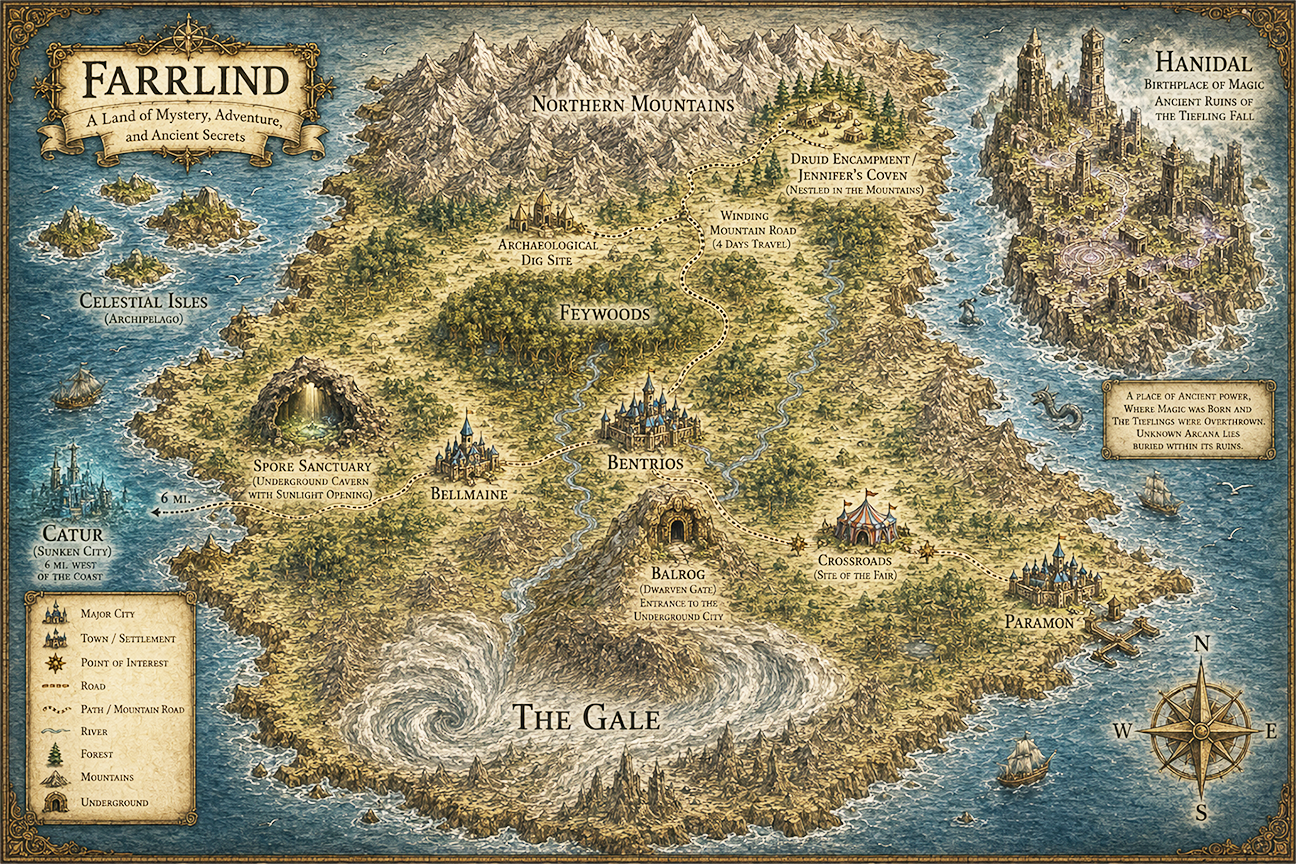
The Gale had not finished with us, not truly. It had thrown ice, wind, monsters, death, and the kind of cold that makes even thought move slowly. A giant named Rassel had guided us from that place toward the monastery, kind enough in the way only very large people can afford to be. When one is the size of a modest building, gentleness becomes both impressive and reassuring.
But kindness does not make the dead lighter.
I knocked at the monastery door and spoke in Old Common. I said we had lost a companion and sought permission for burial rites. The words felt strange in my mouth. Not because the language was old. Old words are often more comfortable than new ones; they have had time to learn grief. No, they felt strange because I was using them for Bridget, and some part of me still expected her to object to the formality.
She did not.
The eye-slit opened. A voice answered in the old tongue. Then the door opened, and there stood Histata: a gnomish woman no taller than a child and older than the assumptions of everyone in our party combined. She wore the garb of the monastery and a badge upon her shoulder, and when she welcomed us inside, she did so with the calm of someone who has seen travelers arrive with worse than weather clinging to them.
She said it was good to know the old words were not lost.
I told her words are never lost with me.
It was a true thing. It was also a foolishly proud thing to say while carrying a friend I could not call back with any word I knew.
Inside, the monastery was warmer, quieter, and stranger than comfort allows. Histata spoke of Po, of open hands, of discipline and silence. She looked at Mikani when Namaloa was named, taking that in without giving much away. The monks here do not waste expression. They spend it like coin, and only when the price is worth paying.
We were given leave to bury Bridget. Histata called for her son, Ipipip, a young monk with too much history in his head and not enough years in his bones. He led us through ornate hallways toward the graveyard, and there the walls began speaking before any monk did.
The halls were covered in images and old writing, the sort that catches the eye of anyone cursed with literacy and curiosity. I translated what I could for Mikani and the others: Hesterahango, or Hesterah, tied to frost giants and dragonkin of the Gale during the Million Years' War. The founding of the monastery. The five tenets of the Open Hand. A story laid out in stone, ink, and silence.
And beside Hesterah there was another figure.
A name had been scratched away.
Not worn by age. Not lost to weather. Removed.
There is a difference.
I wanted to stop. I wanted to ask questions then and there, because I am a bard and therefore constitutionally unsuited to leaving a mystery unpoked. But Bridget was with us, and the hall could wait. History, I have found, is patient in a way the dead should not have to be.
So we went to the graveyard.
Rayetta tended it: a tiefling monk with amber skin, red eyes, curling horns, and the practical air of someone who can discuss burial rites shortly after punching an undead thing back into death. I found this both alarming and appropriate. If one must bury a friend in a strange monastery at the edge of a storm-wounded land, it is oddly comforting to meet someone who treats the restless dead as a solvable problem.
We dug.
I hate the simplicity of that sentence.
We dug a grave for Bridget.
Mikani prepared the funeral rite, a ritual that would protect Bridget's body from undeath for seven days, barring powers so great they hardly belong in ordinary speech. We tried to remember whom Bridget worshipped. That should have been easy. We had traveled with her, fought beside her, laughed with her, drank with her, been insulted by her in all the small affectionate ways that become the furniture of friendship.
And yet we did not know.
Not truly.
We knew nature. We knew enough to speak toward Namaloa and toward the gods of green things, wild things, living things. We knew enough to know we had not asked her while she was alive, which is the sort of failure that does not look like failure until it is too late to repair it.
Corvinas chose silence after the rite, a vow for the dead. I found that fitting. Words are my craft, but silence has its own grammar, and grief sometimes understands it better.
I prepared what little I could. Her body was small. Too small. I have carried many things: instruments, secrets, lies, blades, hopes that should have known better. Nothing has ever felt like the weight of someone who should still be laughing.
When the grave was ready, I poured beer into the earth for her.
It was not theology.
It was Bridget.
Then I sang.
I had written the lament because there was nothing else to do with the wound. It was not a tavern song. It was not meant to win applause, coin, or favor. It was not even meant to be beautiful.
And then, somehow, it was.
I have sung for coin, for kings, for drunks, for frightened villagers, for soldiers pretending not to be afraid, for lovers too foolish to speak plainly, and for myself when silence became too sharp. I have sung well. I know I have. Vanity is one of the smaller sins available to a bard, and I have sampled from that table generously.
But I have never sung like that.
Not once.
The lament came out of me as if grief had found a door I did not know I had left open. My voice did what voices sometimes do when the heart has broken clean through all its defenses. It found the note beneath the note. It carried what I could not carry. It was reluctant, raw, and more true than skill alone has any right to be.
The monks came to listen.
Some had not listened to music in decades.
I wish Bridget had heard it.
No.
That is not true.
I wish I had never needed to sing it.
When the rite was done, divine power settled over her body like a final guard at the door. Mikani's prayer, Po's quiet house, Namaloa's green mercy, whatever gods had the decency to listen: all of it gathered there, not to return Bridget to us, but to keep one more cruelty from touching her.
It was not enough.
It was what we had.
Afterward, the monastery resumed being strange.
Samuel appeared, or was spoken of, or moved through the edges of things with the particular talent of a man who causes conversations to lower their voices. Mother Superior was angry with him. There had been warning of an attack, then no attack. A name was spoken somewhere we could not hear it clearly. A lie was accused. Trust was cracked. Someone was given one more chance, and the threat beneath that mercy was sharp enough to draw blood without being spoken twice.
We were taken to safety and allowed rest, which we badly needed. There is no dignity in exhaustion. There is only the body collecting debts the spirit insisted it could postpone.
Later, I spoke with Mother Superior about the murals and the scratched-away name. I did so in Old Common, partly for privacy and partly because old truths seem to prefer old doors. She told me enough to make the missing name heavier: someone who had once stood with them, or near enough to matter, had made a deal with devils during the Million Years' War. The monastery, strange as it sounds, has old ties with demons, and if Salazar or some other infernal ambition now moves against the Wells, then even ancient alliances may be starting to rot from within.
I told her what we knew. The dragon in the Gale. The Wells. The theft. The possibility that Salazar is behind more than smoke and fear. I kept the conversation close at first, and I could feel the party's suspicion gathering behind me like weather.
They are not wrong to suspect secrecy from me.
That is an uncomfortable sentence to write.
I did tell them afterward. I apologized for holding the conversation apart. I said I was trying to gain trust. This was also true. But truth, I am learning, is rarely innocent merely because it is accurate. I have kept secrets before. I have had reasons. I always have reasons.
Reasons do not always absolve.
The monastery itself seems built from reasons no one wants to say plainly. We passed by chambers and heard fragments of conversation. Samuel's name again. Mother Superior's voice. A question: who was it that spoke to you? A name we could not make out. Later, near the library, Roon and I heard hushed voices around a corner. One voice said it was for the good of the monastery. Another spoke over him. There was talk of protections being vast, of Mother being frighteningly powerful, of speaking with Samuel.
Then a young elf in monk's garb emerged carrying one of the books about the wells.
Books about the wells, dear reader.
I do not like when history grows legs and walks into closed rooms.
We considered eavesdropping more aggressively, because apparently grief had not cured us of being ourselves. Greater invisibility was attempted and failed against a pressure in the air: psychic static, some ancient artifact of Mother Superior's that prevents spellcasting by those she has not permitted. I admire the utility of such a defense. I resent being on the wrong side of it. Both feelings are allowed.
There is something beneath this monastery. Not literally, perhaps, though with our luck it may be literally as well. There is a tension here, a silence wearing robes, a history scraped clean in places where names should be. The monks are polite. The halls are beautiful. The protections are powerful. The graveyard is tended.
And secrets whisper in the corners.
We went to the library because when a place is full of secrets, one should always begin by asking the books what they are willing to betray.
The library was old in a way that makes dust feel scholarly. Treatises on the Gale. Studies of frost creatures. Histories of monastic tradition. Texts on Po and the Open Hand. There we met Bedrock, an earth genasi monk-wizard of considerable size and very small spectacles, which is precisely the sort of contradiction that makes the world worth enduring. He was not officially the librarian, which is something only a librarian would bother clarifying.
We asked about the Wells.
The books were missing.
Of course they were.
If there is a shelf in this world containing exactly what we need, someone has already removed it, hidden it, cursed it, or checked it out without signing the card.
Bedrock did not think they had left the monastery, which was both reassuring and not reassuring at all. A missing book in a secure monastery is not less suspicious because it remains indoors. It is, in fact, suspicious with better walls.
We found other things. A book on the Rim Islands. Notes on the Celestial Isles and their volcanic birth, shaped by the four elemental gods and their father, Ederl. No great revelation, perhaps, but another thread tied to the Isles, to Mikani, to dragons, to the outer edges of maps where people once believed the world ended because imagination had not yet learned to curve.
Roon borrowed the Tome of Ice Nasties, Volume Three, a title so practical it borders on poetry. It is apparently a compendium of things that want to eat you, kill you, freeze you, or some rude combination thereof.
In other words, travel reading.
By day's end, we had buried Bridget, met Histata and the monks of the Open Hand, read history carved into halls, learned that names can be removed but not made harmless, found a library with precisely the wrong missing books, and heard secrets moving through the monastery like mice behind the walls.
We are to speak with Samuel.
We are also still meant to speak with the Well.
I should be thinking about both. I should be arranging facts, motives, dangers, possibilities. I should be writing down every scratched name, every whispered phrase, every signet badge and strange look.
But tonight, I keep returning to the grave.
To the beer sinking into the dirt.
To the silence after the song.
To the fact that the monastery has kept its history for nearly a thousand years, and Bridget has already become something I must work to keep from fading.
So let this be written plainly.
Bridget is buried at the Monastery of the Open Hand.
She lies beneath stone, prayer, song, and whatever mercy the gods can still be shamed into giving.
And if secrets are being kept in these halls, they had best pray they are worth the dead we carried to reach them.