Session Twenty-Four — 07/12/26
1832 AS — Namal 26 into Namal 27
The Gale Does Not Believe in Straight Lines
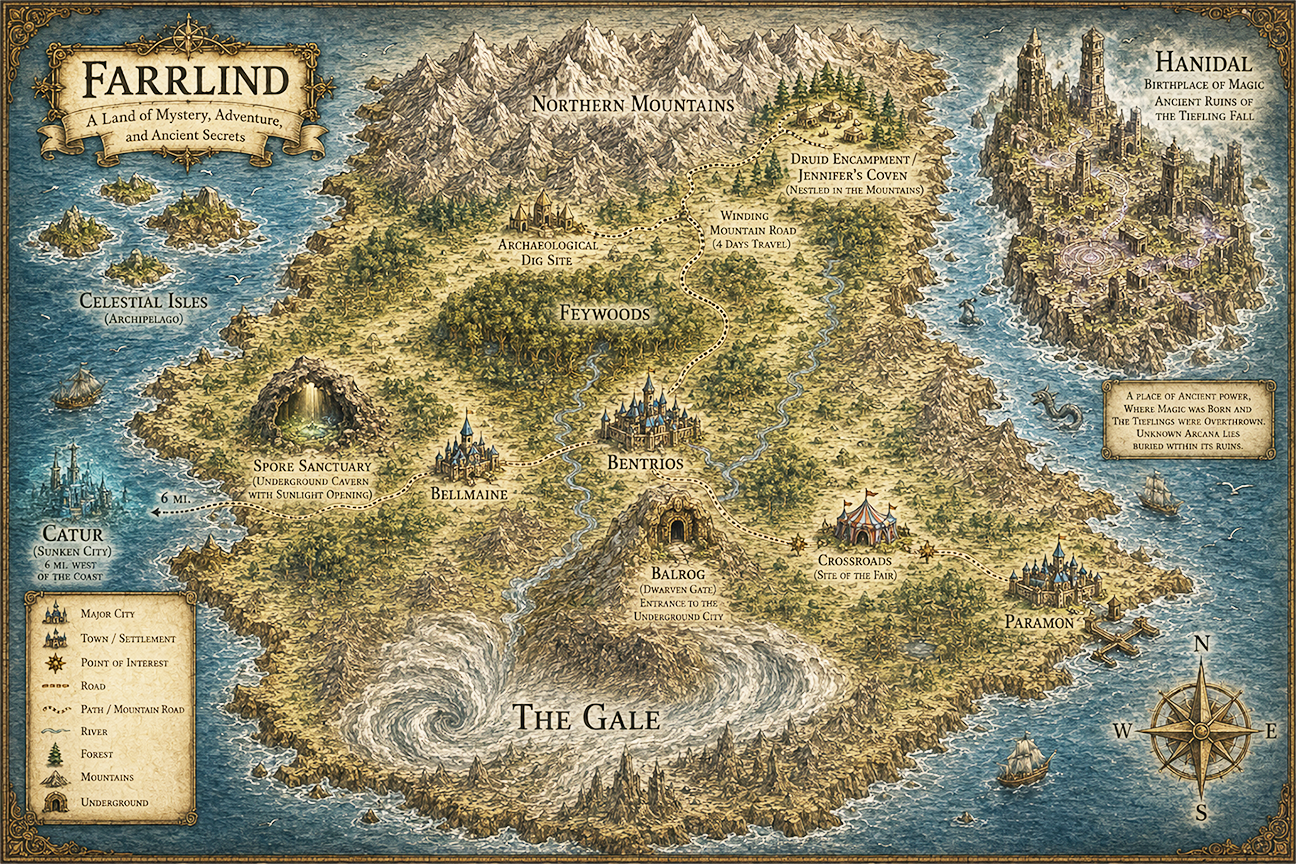
There are maps, dear reader, and there are promises. One should never confuse the two. A promise says, "I will get you there." A map says, "Someone survived this route once, and had enough confidence afterward to draw lines about it." This distinction becomes especially important when the map was provided by a strange little cartographer at the edge of The Gale, and the destination is the Monastery of the Open Hand, a place sensible people apparently refuse to visit without payment, preparation, and a firm belief that death mostly happens to other travelers.
We had the map, the rope, and warning enough to know that patrols sometimes moved through the Gale. We also knew the storm itself was dangerous, and that the region was less a place than a sustained disagreement between Farrlind and the Elemental Plane of Air. We had Roon's new winged boots as well, which had already attracted the attention of a white dragon. Most people would treat that as an omen. Roon treated it as useful information, which is one of the many reasons I admire him and fear for him in roughly equal measure.
On Entering Weather That Hates You
Before stepping fully into the Gale, we discussed formation, rope, visibility, and the likelihood of being blown into distant regrets. There was also some conversation about whether certain smaller members of the party should be secured before becoming airborne, a suggestion Brigit did not appreciate as much as the rest of us did. In her defense, the remark was impertinent. In our defense, it was funny.
The wind howled before we even committed ourselves to the path. Snow moved sideways, the sky vanished into white, and the world reduced itself to rope, boots, breath, and the vague outline of the person foolish enough to be walking in front of you. There is courage, and then there is simply continuing forward because turning back would require admitting the map had won. We continued.
The cartographer's route was not direct. It bent and wandered, marked not as a soldier would mark a march, but as a man would mark a memory: a ravine, a carved cave, points of interest. Points of survival, I thought. We argued briefly over whether to follow the path or cut across the storm, and there was talk of levitation, gaining a better view, and finding a straighter road. I reminded everyone, in the politest possible terms, that placing oneself higher in a storm where a white dragon had recently shown interest in airborne targets was not on my list of preferred strategies. My list is not long, but it begins with "do not be eaten." We followed the map.
The Ice Cave
After hours of wind, cold, and the particular misery of snow finding places on the body snow has no business knowing about, we found the cave. It offered blessed shelter, reduced wind, and only slightly less death. I will take what I am offered.
The cave was not merely a hollow in the ice. Its walls bore carvings: crude figures, old beyond easy naming, worn by time and cold. We saw shapes of people, caverns, ice, monstrous forms, and what may have been a dragon. There was no writing, no Old Common, no arcane script, and no elegant grammar waiting for a bard to flatter himself by translating it. These were older than writing: story before letters, memory carved where song alone could not be trusted to last.
I found that more moving than I expected. Before ink, before books, before proper histories and scholars arguing over footnotes, people still needed to remember. They needed to warn, to teach, to say: this happened here, or this may happen again, or this is how we lived when the world was cruel and large. A bard understands that instinct. We are all, in our own ways, wall carvings with better footwear.
The images did not answer everything. They did not tell us how to reach the monastery, nor whether the dragon was guardian, predator, or merely hungry. What they did tell us was that this place had been feared and remembered long before us. That is rarely comforting, but it is often useful.
A Suspicious Floor
Deeper in, the cave widened. Most of the chamber was low enough to feel oppressive, perhaps twenty feet high, but farther back it opened into a stranger dome that rose near sixty feet above us. Beneath that dome lay a patch of ice thinner than the rest, smooth and bare where formations should have gathered. Faban Colon, renowned investigator and occasional survivor, immediately reached a sound conclusion: no.
Thin ice is one of those invitations nature writes in a language even fools can understand. It says, "Please stand here so I may reveal the next problem." I declined. Others, being more curious and less devoted to the preservation of my nerves, considered what it might mean: a passage, a weakness, perhaps a place where something came through. The last thought did not improve morale.
Brigit's Shortbow of Warning did not stir, which was reassuring until we remembered that magical weapons, like many bureaucrats, are very specific about when they consider something officially a threat. If it has not decided to kill you yet, apparently everyone may remain calm. I have never trusted definitions written by weapons.
The Watch
We decided to rest, which was wise, necessary, and exactly the sort of decision people make in stories shortly before discovering they are not alone. We arranged watches and discussed distances. Thirty feet mattered because Brigit's bow cared about thirty feet, and we considered tripwires, sight lines, backs to walls, entrances, exits, and the unsettling fact that one of the exits might be a suspicious patch of thin ice leading gods knew where. I had whiskey, which improved the plan. Not strategically, perhaps, but spiritually.
During the watch, something moved. Roon saw it first, a shape passing from the entrance deeper into the cave, not attacking, not pausing, and not announcing itself with the courtesy expected of monsters in polite society. It simply went by. Four legs? Six? Eight? No one could say. The bow did not shriek, combat did not begin, and the thing either did not see us, did not care, or had business elsewhere more important than murdering travelers. This is a deeply unsettling category of creature.
We called it a ghost because people like naming things, and a name gives the illusion of understanding. We did not understand it. Those on watch did what watchmen are meant to do: watched where it came from, watched where it went, and prepared to wake the others if the cave decided to become more actively hostile. The cave waited, which may have been worse.
Morning, Such As It Was
We completed the rest, which was good. Then the ceiling cracked, which was less good. There are sounds one learns to interpret quickly on the road: the snap of a bowstring, the intake of breath before a spell, the wet scrape of something climbing where nothing should climb. Ice cracking overhead is among the more persuasive.
Before warning became action, the entrance collapsed. Not upon us, thank the gods, but in front of us. The storm was outside, we were inside, and between the two stood a wall of ice, stone, and inconvenience large enough to suggest that starvation had been placed upon the list of future concerns. I objected to this ordering. Starvation, in my opinion, belonged well below "the unknown thing deeper in the cave," "the suspicious thin ice," "the dome that should not be there," and "whatever cosmic force continues arranging my life as though it were a tragedy with comic timing."
We considered options. Could Mikani command the ice as water? No. Ice, it seems, becomes pedantic at the worst possible times. Could Knock open the obstruction? No. The cave-in was not a door, despite behaving very much like one with an attitude problem. Could I Dimension Door someone beyond the collapse? Perhaps. One person, maybe two, if the gods and geometry were feeling charitable. This is the cruelty of certain magic: it offers hope in quantities too small for comfort, enough to save someone but not enough to save everyone.
So we stood in the ice cave with our packs, our map, our uncertain ghost, our strange dome, our thin floor, and the knowledge that the way forward and the way back had both become questions. I have often said that adventure is what people call poor planning after it succeeds. At present, we are still waiting on the success.
Ink Under Ice
The Gale howls beyond the blocked entrance, and the monastery still waits somewhere ahead. A white dragon circles the storm, or does not. A ghost moves through caves, or is not a ghost at all. Ancient people carved warnings into ice and stone before language had learned to behave itself, and we, modern fools with better boots and worse judgment, have followed their marks into the dark.
I keep thinking of those carvings, not as decoration or relics, but as memory trying to survive weather. Perhaps that is all any diary is: a carving made in softer material, a note left for the next poor soul who comes this way and wonders whether the road ahead is survivable. So let this be my mark. We entered the Gale, found shelter, and shelter became a trap. Something passed us in the dark and did not strike. The old stories are still here, and once again, we are inside one before knowing how it ends.
Yet the ice and the ghost are not what trouble me most as I write. I keep returning to the choice I made before we came here, when I opened the truth beneath the satchel and placed the burden of the Grimoire before my friends. I told myself it was necessary. I still believe that. But belief is not the same as certainty, and certainty has become a dangerous word in my life.
If the book is what I fear it is, then knowledge is not merely comfort. It is weight, temptation, weapon, and wound. By telling them, I made them part of its gravity. I told myself I was ending a loneliness, and perhaps I was. But I also handed them a truth that cannot be unknown, and I do not yet know whether that was trust or selfishness wearing the face of trust.
So here, trapped beneath ice in a cave older than writing, I ask the question I could not ask aloud. Did I choose rightly? Did I place my faith in the people strong enough to carry this with me, or did I merely spread the danger wider because I was tired of holding it alone? I want to believe I put my trust in the right people. Gods help me, I need that to be true.