Session Twenty One — 05/17/26
1832 AS — Namal 25
Of Heros, Lunatics, Sailors and Boats
There are moments, dear reader, when one realizes that the line between heroism and lunacy is not a line at all, but rather a small boat, six miles from shore, crewed by a half-orc sailor of uncertain nautical pedigree, a paladin trying very hard not to lie, and a bard whose best plan involved pretending to be only somewhat wet.
Such was our road to Catur.
We began the day still turning over the words of the well we had reclaimed. It told us that the other wells may not be easily persuaded, but that ancient things — fiendish or celestial in nature — might sway them. Naturally, we began taking inventory of everything strange, cursed, holy, questionable, or found in a bag and forgotten. The fragments of that orb came up at once. Corvinus’s blade was considered. Roon’s greatsword of life stealing drew several thoughtful looks, as things called “life stealing” rarely come from orphanages and hymnals.
I checked my socks. They are not fiendish.
I cannot speak for Brigit’s.
We also took stock of our new gifts, for Balrog had not sent us toward the sea empty-handed. Mikani now wears a cap that grants her breath beneath the waves, awakened by the word Kokyu. Brigit carries a shortbow that warns of hostile intent. Roon bears a dwarven shield of formidable make, and with it has become even more difficult to strike than before, which is saying something. Gildas holds a Staff of Defense, a most sensible thing for a wizard who prefers not to be touched by sharp objects, blunt objects, claws, teeth, curses, or most forms of conversation.
Corvinus has a sword that burns even beneath the water. I find that comforting and deeply unnatural.
As for me, I carry the Acheron Blade — black, elegant, and not at all reassuring. It bites more keenly than common steel and bears a dread within it that can be passed to those unlucky enough to meet its edge. It may also grant me a small darkness of strength when needed. I am trying not to think too much about the source of that blessing.
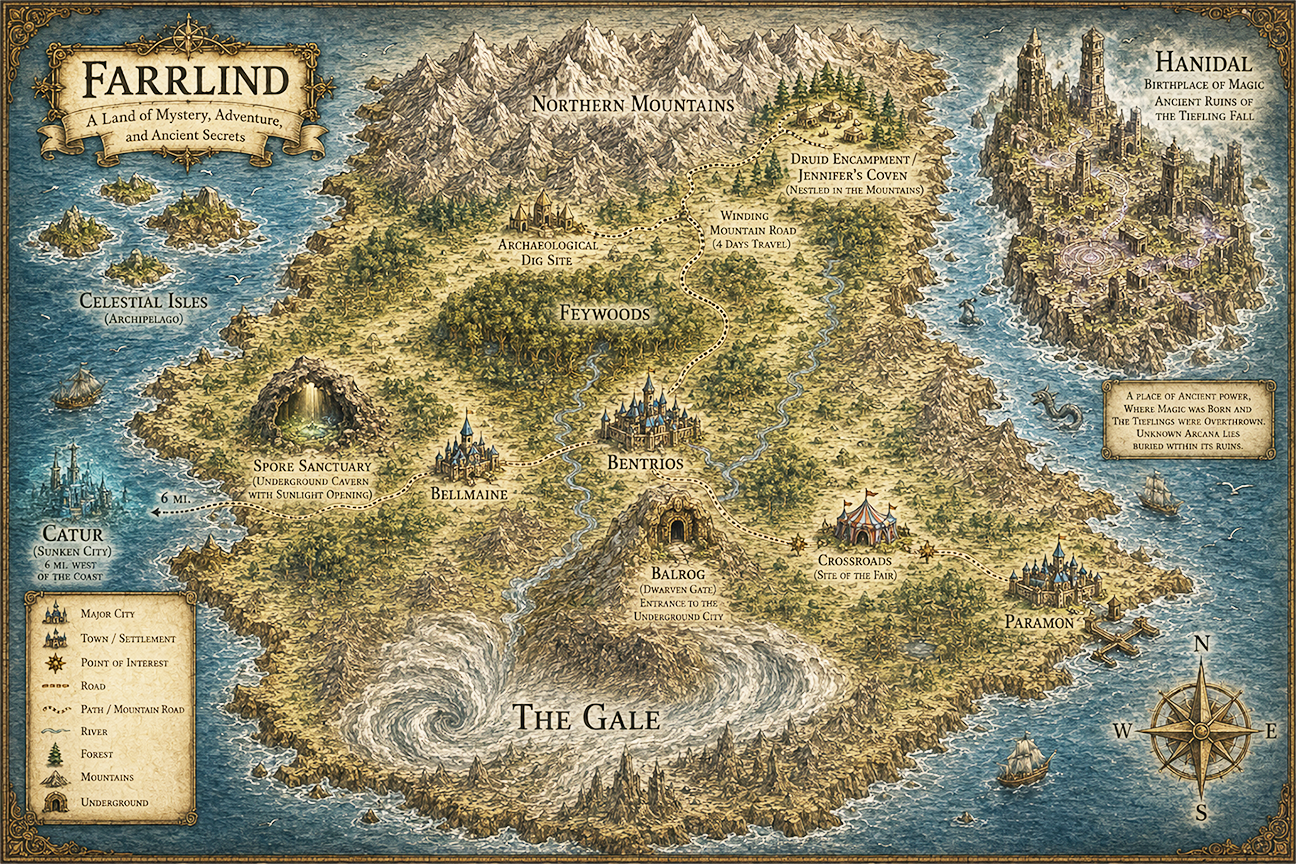
From the coast near Catur, we learned again that the city itself does not sit upon the shore. Catur lies beneath the ocean, some six miles out, drowned or hidden or both. The giant fishermen of the coast gave us what wisdom they had: there are mushrooms that allow breath underwater, the city does not welcome outsiders, and disguises would be wise. We had gathered twenty-eight such mushrooms, and Gildas had already prepared twenty potions of water breathing. A generous supply, though nothing makes a man count hours quite like the knowledge that breathing has become a consumable resource.
Naturally, we decided to go immediately.
Our plan, such as it was, relied on the noble arts of diplomacy, improvisation, and placing Corvinus somewhere he would not have to answer questions. Mikani would present herself as an emissary of the Celestial Isles. I would accompany her as a water-touched human, a friend to the Isles, a believer in Namaloa, and a man whose relationship with the sea could be described as spiritually moist.
The others would serve as our escort and protection.
This raised a delicate matter concerning Corvinus. His oath binds him to truth, honor, compassion, and the sort of moral clarity that makes life difficult for the rest of us. We therefore resolved that the best way for him to preserve both his oath and our necks was to say very little. This, I should add, is a strategy I have recommended to many people over the years, though rarely for such holy reasons.
Rune took command of the boat, which was either an act of confidence or collective desperation. To his credit, he kept us moving in the correct direction and did not once sail us in circles, which immediately places him among the better captains I have known. I kept watch. Mikani looked every inch an emissary of the Celestial Isles. Brigit remained Brigit. Gildas, I suspect, was doing calculations in his head that would either save us or depress him. Corvinus looked stoic, which is to say he looked like Corvinus.
I Remembered Why I Hate Boats
The sea was calm at first, almost insultingly so. We passed an hour in uneasy quiet. Then, as we drew nearer to the place where Catur waited beneath the waves, the water changed. It grew choppy. The boat rocked. I thanked every god of music, mercy, and digestion that I had not taken too much wine.
During the crossing, Mikani and I spoke of the Celestial Isles so that I might not be caught utterly ignorant if questioned. I learned more of that place: a land of dragonborn and kobolds, of dragonkin who endured after the fall of dragons, of a constitutional monarchy ruled by the gold dragonborn high clan, the Mensen. They are known in the Outer Rim for appraising gems and artifacts. This suited our cover well enough. I have always found that a lie goes down easier when wrapped around a kernel of truth and spoken with confidence.
I did attempt to improve my appearance for the role. Perhaps a little makeup to suggest gills. A touch of sea-born mystery. A hint of water-touched grace.
I failed completely.
There is no kinder way to record it. Whatever I did, I did not become more aquatic. I may have become more suspicious.
Still, the sea took us.
Beneath the surface, Catur revealed itself not merely as ruin, but as a living place. There were cultivated corals, strange mushrooms, gardens beneath the water, and signs of people who had made the impossible ordinary. We were not granted free passage through the city, but we were brought to a courtyard, watched carefully, and treated as guests only in the thinnest and most conditional sense of the word.
We learned of a smith named Uthgar, whose work may yet matter to us, though the greater purpose pressed harder. We had not come to admire underwater craft, nor to make trade, nor to perform at a tavern that would almost certainly have terrible acoustics.
Of Royal Meetings and the Danger They Bring
At last, we were brought before the Queen of Catur.
There are audiences, and there are audiences. I have bowed before nobles, lied to officials, charmed innkeepers, and sung for men who fancied themselves kings because they owned three vineyards and a chair with arms. This was not that.
She had the stillness of the deep about her. Not silence, exactly. Pressure. The sort one feels before a storm breaks, or beneath too much water, or under the gaze of someone who has ruled long enough to stop wasting words.
We had come to ask after the well.
She asked after a book.
Not merely a book. A particular book. A dangerous book. A book of rumor and pursuit, tied to memory, perception, and the shaping of how things are known. She spoke of it as something sought by powerful people and darker forces alike. Something that had drawn concern for years.
And there I stood, with the thing strapped to my chest.
I could feel it beneath my clothes. Not metaphorically. Not poetically. Physically. Its weight against me. The leather. The hidden pages. The secret I had carried through road and ruin and battle, now resting within reach of a queen who was asking whether I knew anything about it.
Had she stretched out her hand, she might have touched it.
I told her I had heard rumors. That I did not know where it was. That demonic forces and other powers were said to be searching for such a thing. Each word had to pass my teeth carefully, like a blade being drawn from a sheath without ringing.
I do not know whether I lied.
That is the trouble with secrets of this sort. One may tell the truth around them so many times that the shape of the truth becomes a kind of deception. I did not hand her the book. I did not reveal it. I did not confess that the object of her search was close enough to hear my heartbeat, if books hear such things.
And perhaps this one does.
In that moment, all the cleverness drained from me. The role of water-touched envoy, the borrowed confidence, the prepared half-truths about the Celestial Isles — all of it became thin costume. Beneath it was only Faban Colon, bard, fool, witness, and unwilling keeper of a thing too many powers seem to desire.
I have carried songs that changed the moods of rooms.
I carry a book that may change the memory of the world.
A Queen’s Gambit
Whether by reason, necessity, or the quiet grace of Namaloa upon Mikani’s presence, the queen agreed. She led us to the chamber.
It was not what I expected.
The well of Catur was less a stone circle than a great pool of magic hidden in an underwater cave, dormant and deep, surrounded by spires and silence. We stood there before it, uncertain who should speak first. We named what we knew: Korog, Safi, Ordor, the unknown well of the Gale, the unknown well of Hanidal, and now this one. Six wells. Six truths, or six fragments of one truth.
I approached.
I warned the well that the Wand had been stolen. I told it that whoever carried the Wand had undone Ordor, and might come for the others. I told it we sought to prevent that end.
Then the well answered — or something answered through it.
The chamber shifted from mystery to danger in a breath.
Whatever presence guarded Catur’s well knew more than we had said. It knew what we were, or enough of it. Power pressed against us. We were pushed back toward the surface, and then the sea itself seemed to give way to something older than fear.
The Sea Creature
The largest creature I have ever seen appeared.
An aboleth.
Its voice did not reach my ears. It reached my mind.
It named itself Niebain — or Nebain; I must trust later ears for spelling, as mine were occupied trying not to hear my own heartbeat. It did not threaten us first. It warned us.
We are in great danger already.
Then the queen moved aside from a crack she had been holding back.
And the water began to rush in.
So ended the day: not with revelation, but with pressure. Not with a song, but with the roar of the sea forcing its way through stone. Somewhere beneath Catur, in the presence of a queen, a well, and an ancient thing that speaks through thought, we learned that the danger we feared was not approaching.
It had already arrived.
And tomorrow, should we live to see it, I may have to write a song that rhymes with aboleth.
May the gods forgive me.