Session Twenty — 04/27/26
1832 AS — Namal 20
Salt, Steel, and the Distance Between Legends
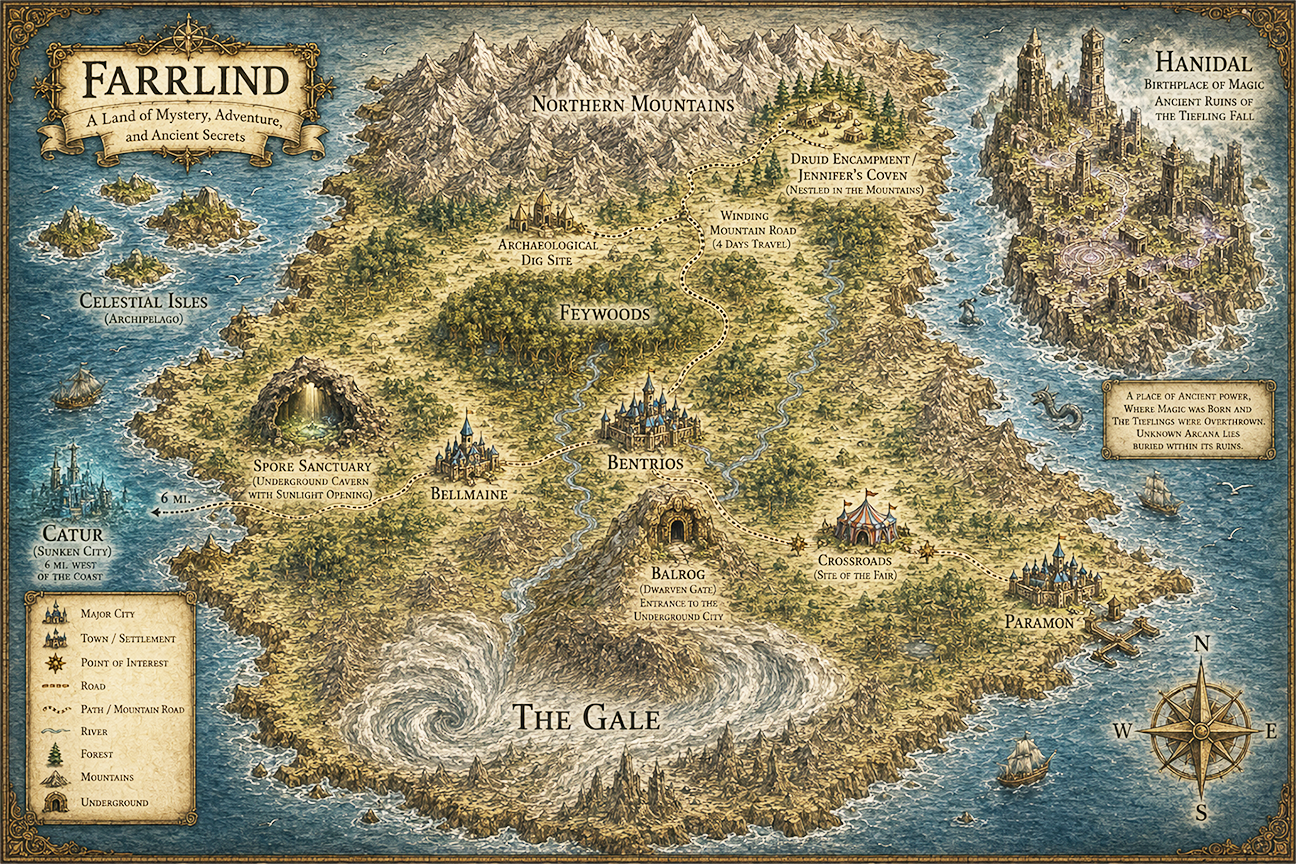
We left Balrog with more than we arrived with.
This is, I am learning, the most dangerous kind of departure.
Not merely coin — though there was plenty of that — nor gratitude, which the dwarves dispense with a peculiar efficiency. No, what we carried away was something less tangible and far more difficult to set down.
Recognition.
Balrog does not exaggerate. It does not embellish. It does not mythologize.
It remembers.
And now, it remembers us.
I am not yet certain how I feel about that.
Dwarven gratitude is not poetic.
It is precise.
They did not thank us with words. They measured us, weighed what we had done, and responded in the only language they truly respect:
Craft.
Each of us was given something.
Not trinkets. Not tokens.
Tools. Statements.
I was given a blade.
Black.
Not merely in color, but in presence. It does not catch the light so much as refuse it. The edge is perfect — unnervingly so — and when held, it feels less like a weapon and more like a decision already made.
I have not yet decided how I feel about it.
It fits my hand too well.
Gildas received a staff.
He examined it with the sort of quiet reverence he usually reserves for dangerous ideas. Even at a glance, I could see the subtle weave of power within it — not aggressive, not volatile, but capable.
It will make him stronger.
This is both reassuring and deeply concerning.
Mikani was given a cap — simple in appearance, almost modest.
It grants her breath beneath the sea.
Of all the gifts, this one felt the most intentional.
The dwarves may not understand the Wells, but they understand necessity. And they understand where we are going.
Water does not forgive oversight.
Brigit’s bow was replaced.
Or perhaps upgraded is the better word.
She tested the draw once — just once — and smiled in a way that would make most sensible people reconsider their life choices. The string sings now, clean and eager.
I suspect many things will not hear it until it is far too late.
Corvinas was given a blade wreathed in flame.
Not illusion. Not trickery.
Real fire, bound to steel and faith alike.
It suits him disturbingly well — a weapon that does not merely strike, but declares. When he holds it, the line between judgment and destruction becomes… negotiable.
I will be watching that closely.
Roon received a shield.
At first glance, this seemed the simplest of the gifts.
It is not.
The weight, the balance, the way it settles against him — this is not a defensive tool. It is an anchor. A refusal. A statement that whatever stands behind it will continue to exist.
Given Roon’s… ongoing relationship with mortality, I find this addition less comforting than it should be.
The dwarves did not explain these choices.
They did not need to.
They saw us.
And they responded accordingly.
1832 AS — Namal 24
Four Days Between Worlds
We traveled for four days.
The road from Balrog to the coast is not difficult, but it is long enough for the world to feel different again. Stone certainty gave way to wind and soil. The clean intention of dwarven halls faded into the looser, less reliable rhythms of the surface.
We spoke, at intervals. Planned. Argued lightly over routes, provisions, the small frictions that remind one that a group is still composed of individuals and not yet a single purpose wearing multiple faces.
I found myself composing.
Something light.
It refused to remain so.
The Edge of Catur
We arrived not by a city, but by its absence.
Catur does not rise to meet you. It does not announce itself above the waterline. There are no walls, no banners, no visible claim to power. Instead, there is coast — salt, rope, wood, and the persistent scent of things that were recently alive.
Fishermen.
Of course.
Every place of great consequence seems to be bordered by those who simply wish to survive beside it.
We were noticed immediately.
Not with alarm. Not even with suspicion. More with the measured curiosity reserved for travelers who look like they have survived something expensive.
One of them — broad-shouldered, sun-worn, and possessed of the quiet authority of a man who has lost arguments with the sea and continued working anyway — looked us over and said:
“Y’all don’t look like you’re here for the fish.”
I considered several responses.
I chose honesty.
“We’re here for what’s under them.”
This did not improve his opinion of us.
They asked practical questions.
Are you armed. Are you staying. Are you trouble.
We answered as best we could, which is to say, incompletely.
There was laughter.
Some of it even directed at us.
We learned what they were willing to share.
Boats missing. Nets coming up wrong. Lights beneath the water where no light should be. One man described something moving beneath his vessel — not with the aimlessness of fish, but with something closer to intent.
When pressed, he said only:
“Not fish-large. Thought-large.”
I am still considering what that means.
Coin was exchanged. Directions were given. Warnings offered in the casual tone of men who have learned not to dramatize what cannot be controlled.
It was enough.
There was a moment — brief, but genuine — where laughter found us again.
It seems certain divine magicks can cure drunkenness.
I maintain this is a misuse of power.
Even so, it was… effective.
The Water Waits
Catur lies below.
We stand above it, for now.
There is a strange sensation at the shoreline — the awareness that an entire world exists just out of sight, pressing upward, patient, inevitable.
We have faced dragons.
We have carried wells.
We have altered, in small ways, the expectations of places that do not change easily.
And now—
we prepare to step into something that does not care about any of that.
Water does not remember you.
It does not honor you.
It does not care how many songs have been written about your survival.
It simply closes.
Ink at the Water’s Edge
There is a distance between legend and reality.
Balrog felt closer to the former.
This place—
this feels like the latter reasserting itself.
Men with nets.
Boats with names.
Salt in the air.
And beneath it all, something vast enough that even the Wells speak carefully when referring to it.
We go down soon.
I find, for the first time in several days, that I am not thinking about what we have done.
Only about what we are about to attempt.
This feels… correct.
Roon lives.
The fishermen seemed to think this was unusual.
I am beginning to agree.