Session Nineteen — 04/12/26
1832 AS — Namal 19 (continued)
Of Teeth, Memory, and What Remains
The dragon chose violence with remarkable efficiency.
There are creatures that posture before they strike. Orsydon did not indulge in such theatrics. He closed distance in a breath and answered our presence with something far more insidious than tooth or claw.
Nightmare.
It is the closest word I have.
The breath did not burn. It did not corrode. It intruded. Thought itself became hostile terrain. Memories twisted at their edges, familiar fears given sharper definition. For a moment, the world was not the square of Balrog, but something older and less forgiving.
I remained standing.
Others paid more dearly.
Corvinas bore the brunt of it with grim resolve, though I saw the weight settle into him. Mikani faltered only briefly, faith catching her where flesh might have failed. Roon—
Roon endured.
That feels insufficient to write, but it remains true.
He met the dragon as though such things were inevitable in his life — steel against scale, fury against enormity. When the creature turned its full attention upon him, I believed, for a single breath, that I was about to record his final moments.
Claw. Venom. Mind.
He did not fall.
I do not fully understand how.
There are limits to flesh. I have seen them. Documented them. Accepted them. Roon appears to treat such limits as suggestions rather than constraints.
I will need to study that further.
The cultists, for their part, contributed what little chaos they could muster — erratic bursts of dark energy, poorly timed attempts at control. They are, in truth, less dangerous than their ambition.
It is their ambition that concerns me.
I attempted to turn the dragon’s attention.
Words, properly placed, can redirect armies. They can unravel certainty. They can plant doubt where none existed. I have relied upon this often.
Orsydon did not care.
There are minds that cannot be persuaded — not because they are simple, but because they are already aligned with something deeper than reason.
That realization was… instructive.
So I changed tactics.
The pattern shifted.
Gildas bent the field itself, fire blooming where it would cause the most disruption. Mikani answered with light — not gentle, not guiding, but absolute. Brigit moved within shadow, each strike precise, each motion economical.
And I—
I constructed.
There are moments when performance ceases to be art and becomes architecture. I shaped space with blade and spell, a whirling storm of edges — a Cuisinart, as I believe I heard it called in the chaos. An inelegant name for a remarkably effective expression of intent.
The dwarf — Lightdelver — proved unexpectedly useful.
It seems we collect peculiar allies.
His magic joined mine, the air itself turned hostile to the dragon’s flesh. Blades unseen carved through scale and arrogance alike, each moment of resistance met with another precise incision into inevitability.
Orsydon attempted to endure.
That, I think, was his final mistake.
Dragons believe themselves eternal in moments such as these. That belief is often justified.
Not this time.
The creature faltered.
Healing magic — unnatural, self-serving — tried to reclaim what we had taken. It was not enough. The pattern held. The structure remained intact.
And then—
It ended.
There is a silence that follows the death of something immense. Not absence of sound, but a pause in the world’s willingness to continue.
The dragon fell.
Roon did not.
Lightdelver was less fortunate in his positioning, though fortunately not in outcome. I am beginning to suspect he survives on stubbornness alone.
The remaining cultists were dealt with swiftly. Without their summoned god, they reverted to what they always were — frightened individuals clinging to ideas too large for them.
We did not linger.
Balrog, it seems, recovers quickly. Dwarves possess a remarkable ability to categorize catastrophe as an inconvenience once it has passed. We were fed, housed, and thanked with a pragmatism I find increasingly admirable.
I performed.
It felt… appropriate.
The Slaying of Orsydon now exists in verse. It is, I admit, a work in progress.
Saiffi required returning.
There is a peculiar intimacy in carrying a being such as that within a wineskin. He resumed his place in the forge without ceremony, as though the last several hours had been an acceptable deviation rather than a disruption of cosmic balance.
He spoke further.
Of items.
Ancient things. Fiendish. Celestial. Persuasive to beings such as himself.
It seems we may already carry fragments of relevance.
This is… unsurprising.
Our path has not been subtle.
More troubling was his mention of the natural order.
We have, it seems, deviated from it.
I find that phrase unsettling.
Not because I do not understand it — I do, in part — but because something within me reacted to it. Not with curiosity.
With recognition.
That sensation again.
That quiet, unwelcome familiarity.
I continue to write the truths that I remember. The truths that I can hold.
But there are edges now.
Places where the ink hesitates.
Places where memory does not arrive cleanly, but instead presses forward like something waiting behind a door I have not yet opened.
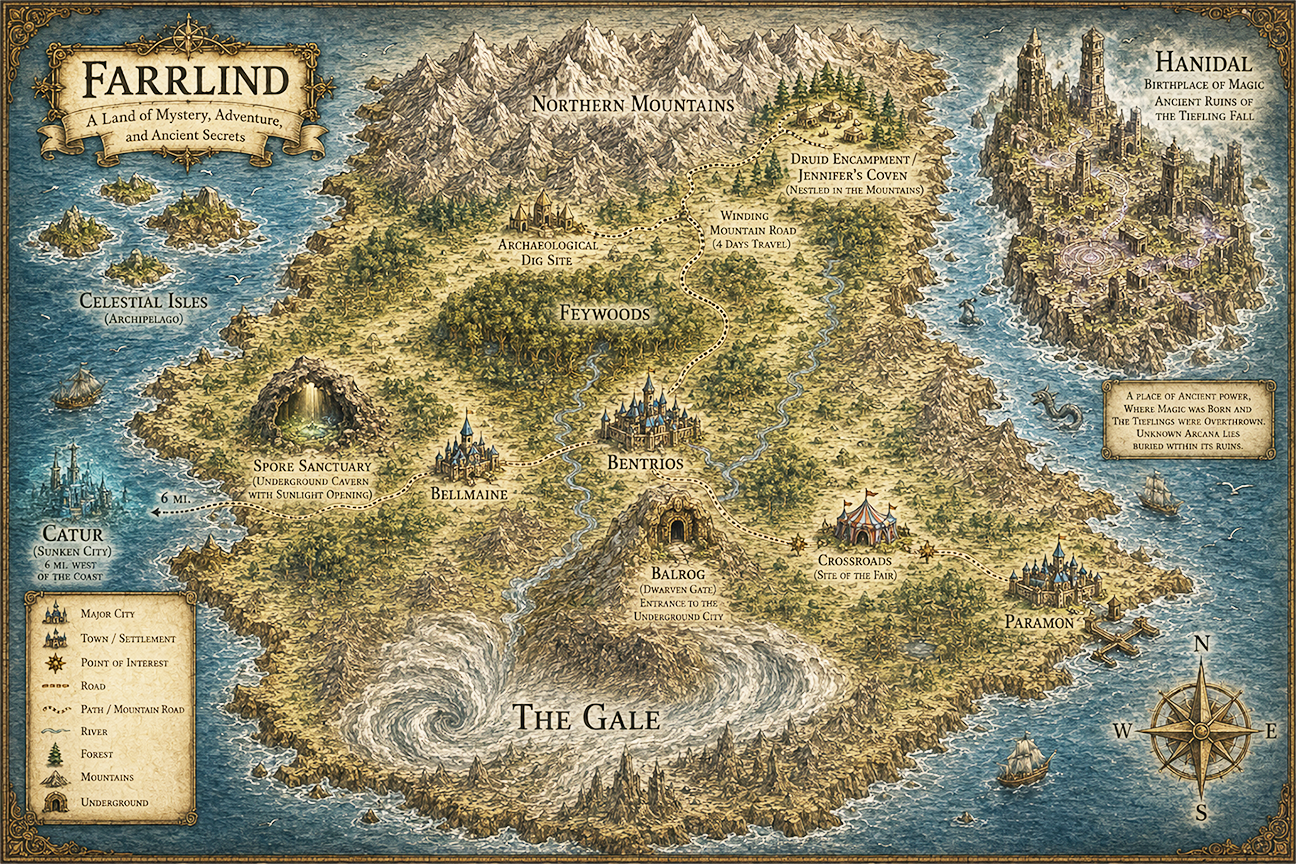
We move next toward the sunken city.
Toward another well.
Toward answers that will, I suspect, raise more questions than they resolve.
This is the work.
To stand in the narrowing space between what is and what must not be allowed to become.
To shape what can still be shaped.
To remember only what one can survive remembering.
—
Roon lives.
For now, that is enough.