Session Sixteen — Remembrance Day (1/16/26)
1832 AS — Namal 12
We woke beneath a quieter sky than I expected.
Remembrance Day came upon us not with trumpets or prayer bells, but with the soft understanding that some absences do not announce themselves. We exchanged gifts — small, personal things, offered without ceremony, as though ceremony itself might fracture under the weight of memory.
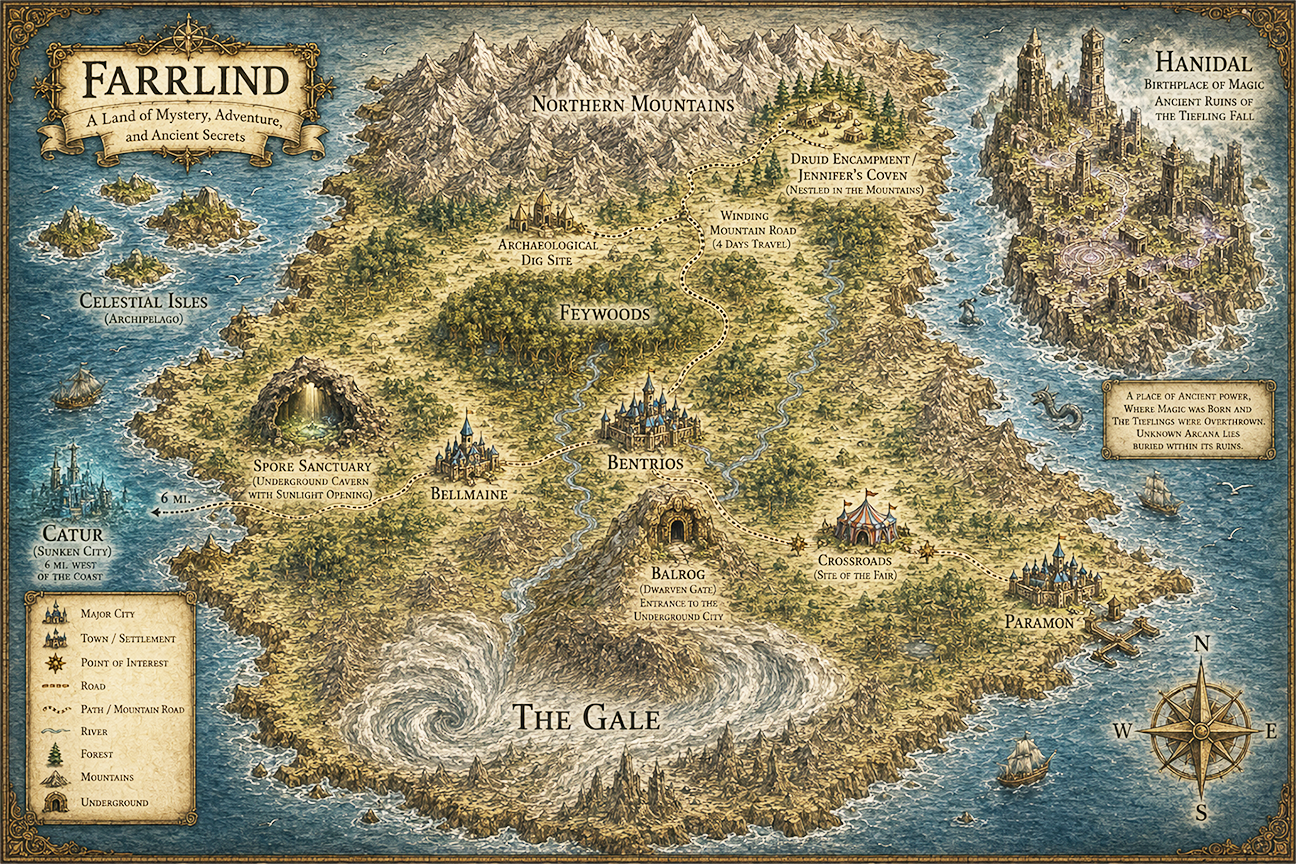
Mikani spoke first. She remembered those lost in the storms of the Celestial Isles — names spoken carefully, like stones set back into a shoreline that no longer exists. Her voice did not break, but the room leaned toward her all the same.
Corvinas remembered his village. He did not embellish. He never does. He spoke of survival as something that does not feel like victory when you are the only one left to claim it.
Roon remembered his shield.
I believe he meant more than the steel.
Brigit remembered her alcohol, and for a moment the room laughed — grateful for the permission.
We feasted that night. The innkeeper outdid himself, and the tables bent beneath plates meant to comfort rather than impress. The night stretched. Glasses refilled themselves faster than caution could keep pace. Laughter came easier. So did forgetting.
And then forgetting failed me.
I grew maudlin. There is no prettier word for it. I sang The Keeper of the Quiet Key.
I do not remember choosing it.
I remember the silence that followed. I remember my voice faltering where it never has before. I remember my hands shaking against the strings. I remember the song ending while the room remained held — as though something unseen had leaned close to listen.
I broke.
Roon took me upstairs without a word. He did not ask. He did not speak. He positioned himself outside my door like a habit learned long before this night. I did not thank him then. I will later.
What followed was told to me afterward, though fragments return unbidden.
Mikani was the first to approach the satchel.
She did not touch it at once.
She described the leather as old, but not worn thin — cared for, as one cares for something that must endure longer than its bearer. She traced the stitching with her eyes, not her fingers. She spoke of the sigils quietly: not decorative, not arcane flourish, but deliberate. Measured. Placed to interrupt, not to repel.
She found the central rune next.
She said it felt older than spellwork. Older than schools. Something closer to vow than magic. It did not push back against her senses — it simply refused to invite them in.
Then she saw the words.
She read them aloud once. She did not repeat them.
Without silence, all is lost.
Without restraint, all will fail.
Without guard, temptation overtakes.
She fell quiet afterward. Not disturbed. Not afraid. Uneasy in the way one becomes uneasy when realizing a rule applies to oneself.
Gildas followed.
Of course he did.
He cast his spell carefully. At first, it behaved as expected. He later told me the layers revealed themselves cleanly: protection, concealment, warding — interlocked, patient, intentionally redundant. Magic meant to delay, not punish. To buy time.
Then something shifted.
The aura did not deepen. It fractured.
Not into colors. Into absences.
He said the more he focused, the less certain he became what he was observing. The magic did not resist analysis — it dissolved it. Categories failed him. Schools lost meaning. The spell continued to function, but its subject refused classification.
He said the worst moment was not fear.
It was when he realized he could no longer remember which spell he was sustaining.
He broke the casting immediately. He did not attempt it again.
Brigit watched the entire time.
She said very little.
She noted how the clasp sat where a blade might expect a weak point — and how there was none. She noted the weight distribution. The way the satchel rested as if balanced even when set down incorrectly.
She said, eventually, that whatever was inside did not want to be stolen.
Not because it was dangerous.
Because it was waiting.
Corvinas did not come upstairs.
He remained in the tavern below. Present. Available. Not absent by accident. I do not know whether this was discipline, faith, or mercy. I suspect all three.
1832 AS — Namal 13
When I woke later, no one asked me to explain.
No one pressed.
At some point — quietly, without vote or declaration — they decided that some truths should remain unspoken until the moment they are needed.
I am grateful. And afraid.
The party’s questions instead found the tasks that remain unanswered.
What faith casts Silence so readily? The obvious answers surfaced: death cults, shard-keepers, Klaus the Trickster, Tesa’s hidden adherents. None sat comfortably.
Mikani spoke of unease — of Iron Paw. The tavern fell quiet when the Celestial Isles were mentioned. I learned then that the eastern coast remembers conquest even when it claims forgetfulness. This was from a commoner, the bar maid whom Roon compensated with a gold piece for her articulateness.
We went to the Namaloan temple where Iron Paw stood waiting. His imposing cat-like presence accentuated by the flicker of the candle light in the sanctuary.
I challenged him. I did not raise my voice. I did not need to.
He answered with a summoning.
A Wasterlich rose, water wearing death like a borrowed cloak. Three fish-things followed, eyes empty of anything resembling faith. The Wasterlich surged through the curtains like a thing born of drowning memory and struck Mikani with a fist of the deep.
Iron Paw revealed himself with eldritch force.
A warlock.
He called forth a tentacle — black, vast, wrong — and declared that we had not seen the full power of the deep.
Mikani answered with ice and storm, cutting the battlefield clean between corruption and resolve.
Steel rang. Magic burned. We fought.
Roon fell beneath the fish-things, and the room narrowed dangerously.
Iron Paw summoned a Dracolich.
It missed Corvinas — I will not pretend that was chance alone.
Mikani returned with healing enough to keep hope alive. Gildas answered with fire that reminded the walls what fear looks like when it is justified. Thank the maker for his magic.
Iron Paw struck Brigit with hellfire and nearly took her from us.
I bent the Wasterlich’s will — Crown of Madness slipping over it like a remembered command. Brigit struck true. Corvinas ended it with divine force that split rot from existence itself. The light was… cleansing.
I struck Iron Paw last.
I do not write that with pride.
Only fact.
We were left standing in a temple that no longer deserved its name.
I do not know what the party thinks now.
I know only this:
I do not fear death.
I fear being forgotten incorrectly.
And I am not yet certain which fate came closest last night. I know that I can never allow myself to lose control again. It is a failure I will not tempt again.